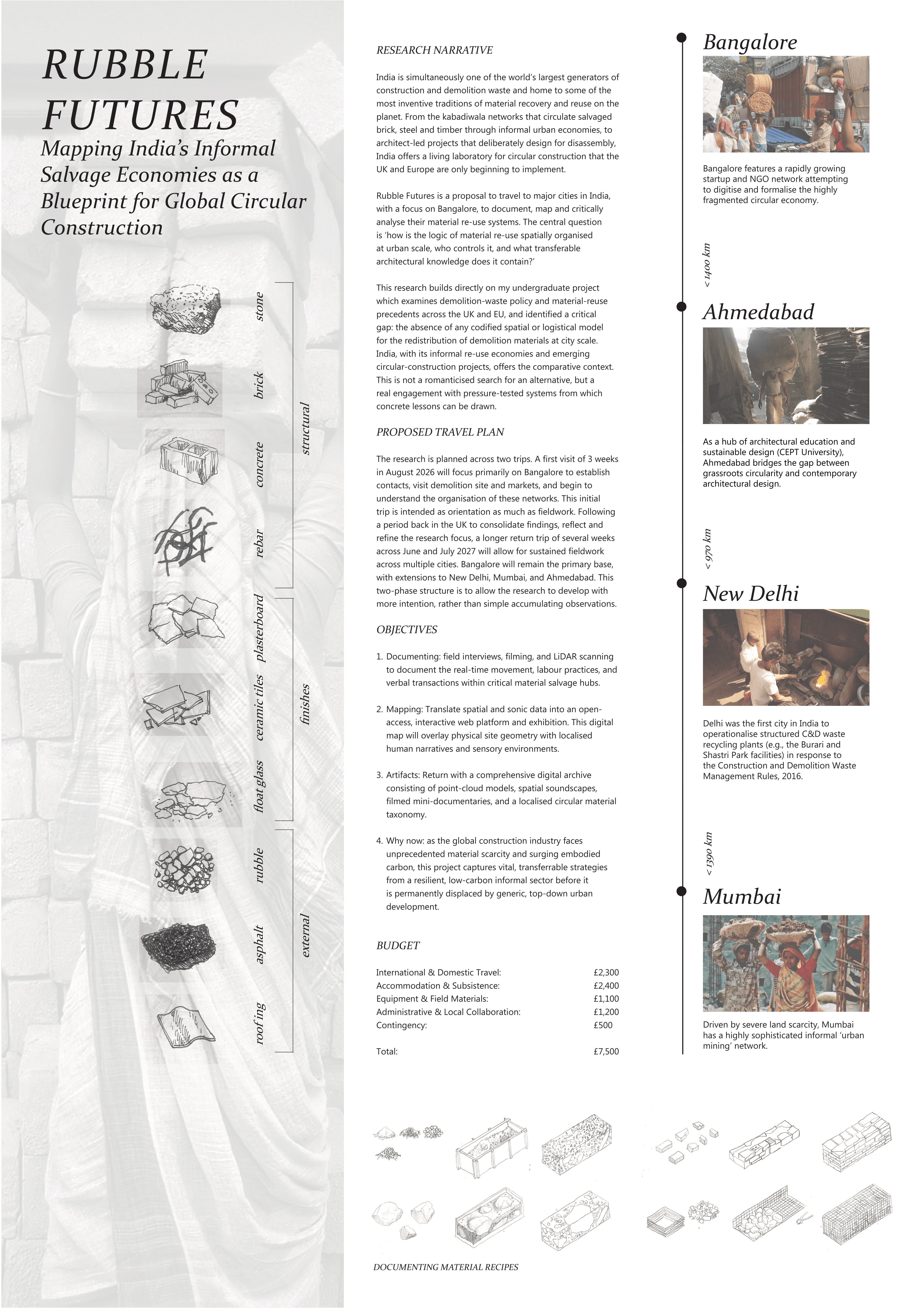
This project has been selected as this year's winner for the RIBA Norman Foster Travelling Scholarship. It is a research project mapping how India's informal and formal material-reuse economies actually work, from salvage networks to architect-led circular construction. I'm an architecture student travelling to Bangalore and other Indian cities and my research asks how the logic of material reuse is organised spatially at city scale, who controls it, and what can architecture elsewhere actually learn from it? The work combines site documentation, interviews, and drawing - mapping both grassroots salvage networks and the architects, startups, and companies formalising circular construction in India.
Scroll down past the proposal poster to read some of my findings so far ↓
On measuring the cost of doing nothing
A recurring theme in conversations with people working in municipal and NGO waste systems: the real comparison isn't the cost of processing demolition waste versus the cost of dumping it - it's monetary cost versus hidden cost. Flooded low-lying areas, silted lakes, stagnant water and the disease that follows rarely make it into anyone's spreadsheet.
One contact framed is simply: treating the symptom, not the disease. Formal waste economics almost never accounts for the value of the land, water, or public health it protects by NOT being dumped on. If this research has a central provocation, it could be here - what would it take to make that hidden cost visible enough for a policymaker to actually act on?
Formalisation doesn't have to mean disappearance
A worry that comes up often, including from people close to this research: that formalising an informal system is just a slower way of destroying it. Municipal takeover tends to push out the networks and livelihoods that built the system in the first place.
But it's not the only model. In Kerala, community-run collection groups (Kudumbashree self-help networks) do door-to-door waste collection while remaining formally linked into local governance structures than being absorbed into a top-down municipal system. It's not construction-waste specific, but it's a usefull counter-example: formal recognition and local constrol aren't necessarily opposites. Worth asking, in every city this research touches, whether anything like this exists here - and if not, why not.
The size of the generator decides which system you're in
A quiet but important split keeps showing up: large developers generally have their own waste processing already built in, simply because of scale. Everyone below that threshold - smaller developers, individual homeowners doing renovations - has no equivalent system, and defaults to whatever's fastest and cheapest, which usually means an informal tractor-load to the nearest vacant lot, lake bed, or flyover.
New national rules are starting to formalise this gap, but they're structured almost entirely around the large end - registration thresholds, recycled-content quotas - while the small end is asked simply to 'segregate and hand over' at best, with little built to make that easy. The formal/informal divide in this research isn't really about culture or tradition. It's mostly about scale.
When reused material becomes a story, not just material
One practice working with construction debris in walls and load-bearing structures made an observation worth sitting with: clients are incleasingly drawn to reclaimed old timber and debris-built walls not because they're cheaper, but because the material now carries a story. A house with a history becomes a kind of aesthetic statement, separate from its environmental cause.
That's not a criticism - it's a genuinely useful lever. But it raises a real question about scale: if reuse only spreads because it's fashionable to a certain kind of client, does the impact stay boutique by definition? The same practice argues that real impact comes from standardising a system - a wall type, a module, a technique - rather than a one-off 'statement' building. Worth tracking whether the story-driven and system-driven versions of reuse can actually coexist, or pull in opposite directions.
Small cities absorb what big cities discard
A pattern raised in conversation with Shamita from the Malba Project deserves more attention than it gets: the story of construction waste in major metros is well documented, but the smaller towns that ring them - the places where a lot of the waste actually ends up - are close to invisible in the research and reporting. She described a nearby smaller city (Thane) becoming, in their words, a 'receptacle' for a much larger city's (Mumabi) waste, with local bodies picking up the fines and consequences for dumping that didn't originate there.
It reframes a question this research keeps returning to: who controls the mateiral, and at what scale? The answer might not sit inside the big city at all - it might sit just outside it, in a place with far less power to say no.
Regulation can prove something is possible and still stop it from happening
UK-based researcher, Alexander Dhesi, working on reuse in construction described a strange trap: planning policy in London now requires large projects to catalogue the materials in a building before demolition and set a target for how much will be reused. On paper, that's real progress - it forces every project to at least have the conversation.
In practice, it can produce the opposite effect. Because a high reuse percentage looks better on a planning document, consultants sometimes commit to numbers - '60% of the bricks' say - with no real plan for how that happens on site, and very little consequence if it doesn't. The policy proves reuse is thinkable, without making it accountable. It's a useful warning for any policy conversation this research eventually feeds into, including in India: a target on paper is not the same as the system on the ground, and the gap between the two can quietly become its own kind of failure, dressed up as progress.
Reuse doesn't win because it's better. It wins because it's cheaper - and only sometimes
Dhesi put a blunt frame on why reuse struggles to scale in the UK: a reused material isn't competing against 'waste vs. non-waste', it's competing against the cheapest possible new product, complete with full warranty and guaranteed performance. Unless scarcity pushes the price of raw material up, or someone finds a specific case where reuse is directly cheaper, there is no real incentive to choose it every time.
The uncomfortable flip side is that in India, reuse is currently cheaper too - but for the opposite reason. Not scarcity-driven pricing, but the absence of enforced alternatives, cheap informal labour, and materials that were never priced as premium to begin with. Two systems can arrive at the same outcome - reuse being the cheap option - for reasons that couldn't be more different. Which raises a really big question for this research: if India's version of 'cheap reuse' is really being subsided by low labour cost and low regulation, does it still count as a transferable lesson, or is it a different phenomenon wearing the same name?
A building without an ending doesn't generate a waste stream - it generates a habit
One detail buried in conversation about 3D printing concrete with Dr. Salaimanimagudam from IISC Bangalore is easy to miss but genuinely structural: India doesn't have the same mandated 'end of life' for buildings that countries like the UK do - no fixed demolition timeline, no equivalent to a pre-demolition audit forcing a building's materials to be catalogued before it comes down. In the UK, that regulatory endpoint is precisely what creates a legible, trackable waste stream in the first place - a moment when someone is forced to ask 'what's in this building, and where is it going.'
Without that forced moment, Indian demolition doesn't produce a stream so much as a habit - buildings come down piecemeal, materials get pulled out and moved on as they're found, absorbed into informal networks as they go, with no single point where anyone catalogues or controls the whole flow. That's not necessarily worse - it may be exactly what makes the informal system so adaptive - but it means the 'who controls it' question doesn't have a single answer the way it might in a more regulated system. Control is distributed across many small, situational decisions rather than concentrated in one audit or one authority. Worth treating that as a finding in itself, not just an absence of regulation.
← Back to homeLet's talk!
Looking to connect with architects, researchers, NGOs, and material-recovery businesses working in this space. If that's you, or you know someone who fits, I'd love an introduction.